We use cards constantly: in Apple Pay/Google Pay, for saved cards online, and in-store. In many of these flows, your actual card number (PAN) is not shared with the merchant. Instead, a token is sent - and it can only be mapped back to your real card inside secure systems run by the card networks/payment providers.
But when you use a traditional bank card, the card itself often carries sensitive data printed on it - such as your name, PAN, and CVV - which means you’re exposing more sensitive information in everyday situations. That’s what changes with a Tapeeze card: the card is anonymous by design and built around tokenization, so you can use it daily without carrying your real card details in the same way.
What is tokenization?
Think of your 16-digit card number (PAN) as your car key. That key can start the engine - in other words, make a purchase.
When you pay via a digital wallet or save a card for fast checkout, this is often what happens:
- The key is not handed over: your real card number is not shared with the merchant.
- A “valet ticket” is created: a token is used instead — a random, non-sensitive string that represents your card in that specific context.
- A token is useless alone: if someone steals it from the merchant, it’s hard to use outside its intended environment.
- A secure vault: the link between the token and your real card is protected in a token vault managed by the networks/payment providers.
In short: the merchant handles a secure placeholder rather than your real card details.
Why tokenization is a major security leap
Tokenization delivers three practical benefits:
1) Faster checkout - without sharing sensitive card data
One-click checkout and subscriptions can work without merchants storing real card numbers.
2) Lower merchant risk (and simpler compliance)
If merchants don’t store real card numbers, the amount of sensitive data they must protect is reduced.
3) More resilient recurring payments
In some setups, the token can remain valid even if a physical card is replaced, helping reduce subscription interruptions.
The Tapeeze perspective: separate the “master key” from the “everyday key”
Here’s the core idea behind Tapeeze’s everyday security model:
The bank card is the master key
It’s the card tied to your bank relationship. You don’t want to block it unless you truly have to.
The Tapeeze card is the everyday key
It’s the card you use daily - in-store, while traveling, and in situations where cards can be lost or end up in the wrong hands.
The key point: if something happens to the everyday key, it should be easy to stop it - without disrupting the master key.
More than payment - Extended usage
Besides its tokenised payment features, the Tapeeze card can be extended with features simplify daily life in transit, physical access, digital car key, loyalty & membership or as mean for Strong Authentication.
All these features are separated and remain secure and tightly controlled due sandboxing whilst they reduce daily frictions on consumers and add value as the card becomes even more personal for each user.
If your Tapeeze card is lost: pause, deactivate, done
When a traditional bank card is lost, it often triggers a chain reaction: blocking the card, waiting for a replacement, updating saved payments and subscriptions, and worrying about misuse.
With Tapeeze, you get a more controlled setup. If your Tapeeze card goes missing, you can pause or deactivate it immediately and make it unusable - without blocking your traditional bank card.
That reduces friction during incidents and keeps your bank relationship intact while you quickly stop the card you actually expose day-to-day.
Why an “anonymous card” matters in everyday life
In a world moving fast toward digital wallets, the physical card remains one of the most powerful and visible touchpoints between people, brands, and everyday life. Not despite digitalisation - but because of it.
A Tapeeze card is designed to be carried, shown, and used. It lives in the hand, on the table, at the checkout, at the office entrance, or at the stadium gate. Unlike a wallet hidden inside a phone, a physical card creates presence, identity, and recognition in moments that matter.
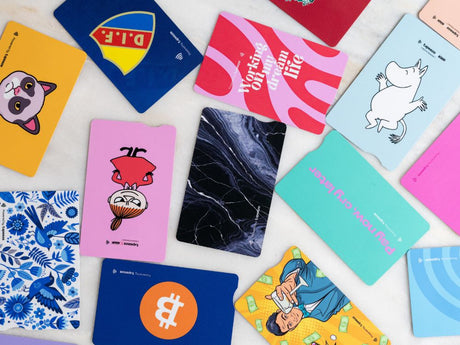
For users, the card becomes an accessory - a reflection of personal taste, lifestyle, or affiliation. For brands, banks, and organisations, it becomes a moving brand surface, seen repeatedly in real-world interactions where digital experiences often remain invisible.
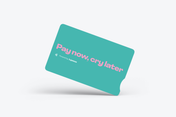
Crucially, Tapeeze combines this physical visibility with an anonymous, tokenized foundation. The card shows who you are - not what you own. No printed names. No exposed numbers. No PAN, and CVV. No sensitive data on the surface. The result is a card that can be expressive without being risky.
This is where physical cards evolve beyond payments.
They become credentials, keys, identity markers, loyalty symbols, and brand ambassadors - all while remaining as secure as a digital wallet.
Summary
Tokenization shifts payments from managing sensitive data to managing secure placeholders. Tapeeze goes one step further by separating your bank card (the master key) from your Tapeeze card (the everyday key).
When the everyday key is lost, the solution should be simple: pause/deactivate and move on - without disrupting your bank card.
Want to learn how Tapeeze can make card experiences safer, more flexible, and more attractive - for both users and banks? Get in touch and we’ll show how an “everyday card” can reduce risk, friction, and stress in payments.